
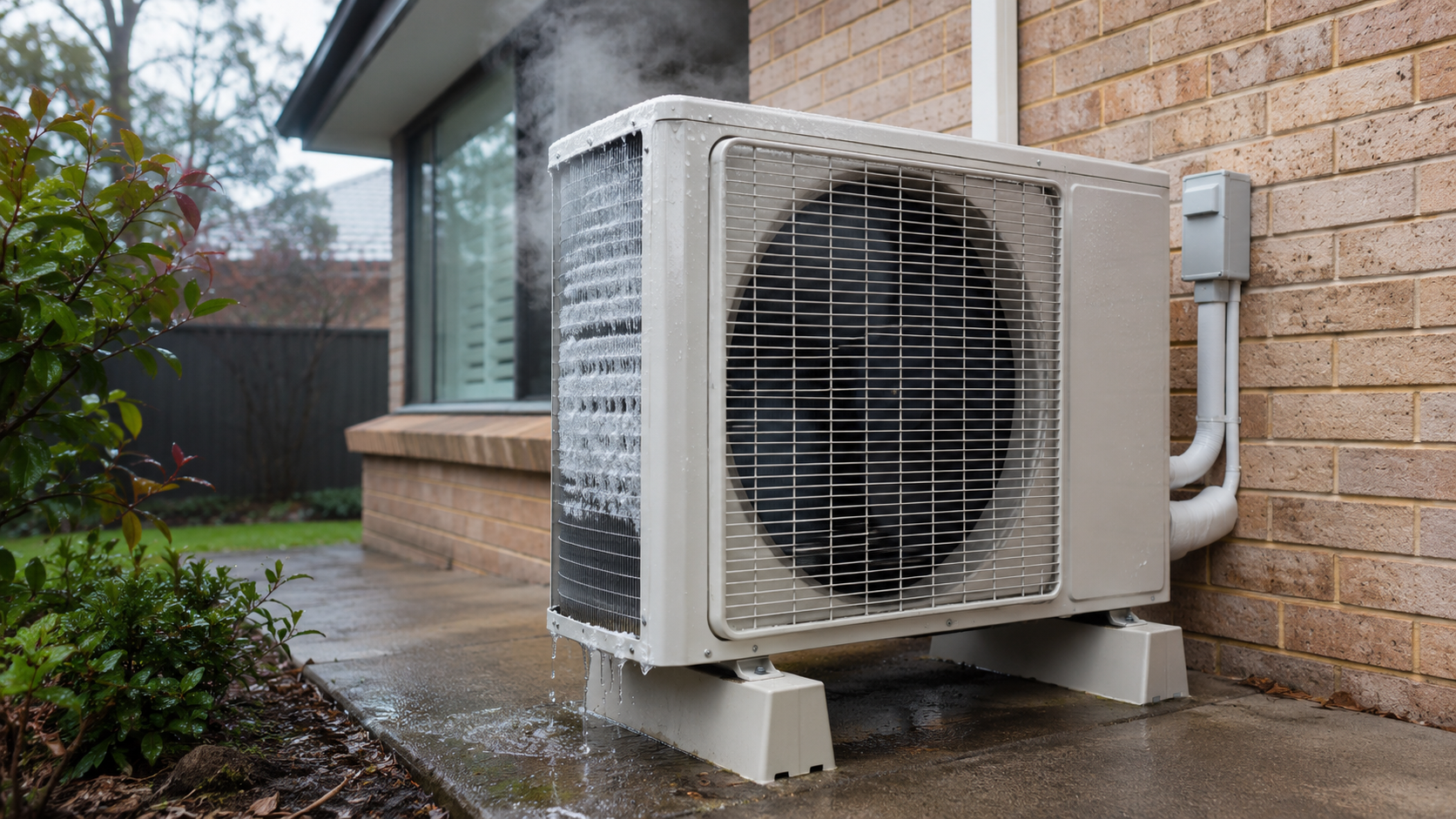
Reverse-cycle air conditioning goes into defrost mode in winter because ice forms on the outdoor coil and blocks the airflow the system needs to pull heat from the outside air. To clear it, the system briefly runs backwards in cooling mode so hot refrigerant gas warms the outdoor coil and melts the frost. Heating pauses for a few minutes, then resumes automatically. In almost every case this is normal operation, not a fault.
At Heating Experts, defrost questions are one of the most common winter callouts we take, and we have now worked with more than 35,000 customers across every Australian capital city. The pattern is nearly always the same. Someone notices the heating stop on a frosty morning, walks outside, sees the fan sitting still with steam rising off the unit, and assumes the system has failed. Most of the time the system is doing exactly what it was designed to do. What matters is how often it defrosts and how long each cycle takes.
What is defrost mode on a reverse-cycle air conditioner?
Defrost mode is an automatic cycle that melts frost and ice off the outdoor heat exchanger during heating operation. The system stops heating your home, sends heat outside instead for a few minutes, then switches back.
Every ducted reverse-cycle air conditioning system and split system sold in Australia has this function built in. It is controlled by the unit itself, not by your wall controller, so you cannot schedule it, skip it, or turn it off.
Why does frost form on the outdoor unit in the first place?
In heating mode, the outdoor coil has to be colder than the outside air. That temperature difference is the only way the refrigerant can absorb heat from the air. On a 5 degree morning, the coil surface may be sitting several degrees below zero.
When air that cold passes over a sub-zero coil, any moisture in it condenses on the fins and freezes. The frost then grows between the fins and chokes the airflow. Once airflow drops, heat transfer drops with it, and the system loses heating capacity fast. Defrosting is how it recovers.
Three conditions drive how quickly this happens:
- Outdoor temperature. The colder the air, the colder the coil runs.
- Humidity. Damp air carries more moisture to freeze onto the coil.
- Airflow around the unit. A unit in a tight, damp or enclosed spot recirculates its own cold discharge air and frosts faster.
Why the heaviest frost forms near 0 to 5 degrees
This surprises most homeowners. Frosting is usually worst close to freezing rather than at the lowest temperatures, because warmer air holds more moisture. Research modelling air-source heat pumps under frosting conditions found that severe frosting occurs near freezing rather than in extreme cold, and that standard methods can underestimate how many defrost cycles happen between 0 and 5 degrees.
That matches what we see in the field. A damp 4 degree Melbourne morning with fog about will trigger more defrosts than a dry, still 1 degree morning in the same suburb.
What happens inside the system during a defrost cycle
The sequence is the same across the major brands we service. A four-way reversing valve flips the direction of the refrigerant, which is the same valve that switches the system between heating and cooling. The US Department of Energy describes how a reversing valve changes refrigerant flow for cooling and for the winter defrost cycle.
In order, here is what the unit does:
- The reversing valve shifts. Hot gas from the compressor is redirected to the outdoor coil instead of the indoor coil.
- The outdoor fan stops. Keeping air off the coil lets it heat up and melt the ice faster.
- The compressor keeps running. Mitsubishi Electric Australia confirms the indoor and outdoor fans stop while the compressor keeps running to melt the frost away.
- The indoor fan stops or slows. This is deliberate. It stops the system blowing cool air through your vents while the indoor coil is cold.
- The controller shows a status. Depending on the model you may see a defrost icon, a standby message, or a flashing light on a wall unit.
One point is worth clearing up here, because much of the advice online is written for the American market. US heat pumps commonly fire electric strip heating during defrost so the supply air stays warm. Australian residential systems generally do not have that backup element, so they stop the indoor fan instead. That is why your vents go quiet rather than cold, and it is why a system blowing cold air through the vents for an extended period is worth investigating.
How can you tell a defrost cycle from an actual breakdown?
Walk outside and look at the unit. Four signs appearing together for a few minutes point to a normal defrost:
- The outdoor fan is stopped, but you can still hear the compressor running.
- Steam or mist is rising off the outdoor coil. This is melted frost evaporating, not smoke.
- Water is draining or dripping from the base of the outdoor unit.
- The indoor fan has gone quiet and the controller shows defrost or standby.
You may also hear a short whoosh or rush of refrigerant as the valve changes position. That noise is the pressure equalising, and it happens at the start and end of the cycle.
How long does a defrost cycle last?
Most defrost cycles finish in under 10 minutes. Mitsubishi Electric Australia puts a typical cycle at approximately 10 minutes depending on conditions and model, and Fujitsu General notes that a cycle ends either on a timer or once the outdoor coil has warmed enough to show the ice has cleared, generally within approximately 10 minutes. On some models a heavy frost load can stretch a cycle to around 15 minutes.
Start-up on a frosty morning takes longer again. Homes Victoria's appliance guides tell residents that on very cold mornings a unit can take up to 25 minutes to defrost and begin blowing warm air after it is switched on. If you turn the heating on at 6am after a cold night, the system may need to clear the coil before it can deliver any heat at all.
Do not switch the system off part way through a defrost. Turning it off or changing the mode ends the cycle early, leaves ice on the coil, and usually means a longer defrost next time.
How often should a reverse-cycle system defrost in winter?
A healthy system defrosts only when it needs to, and there is a minimum interval built into the controls.
Mitsubishi Electric Australia indicates a unit may run for around 40 minutes after start-up before a defrost can begin, and that cycles can then occur roughly every 40 minutes if the outdoor temperature has not risen. Fujitsu General similarly notes most units will not check whether a defrost is required until approximately 45 minutes after start-up.
In practice, across the homes we service:
- Mild, dry winter days. Many systems run all day without a single defrost.
- Cold, damp mornings near freezing. One defrost roughly every 40 to 60 minutes of run time is normal.
- A defrost every 20 to 30 minutes, all day. This is not normal and usually points to a fault, a sizing problem, or restricted airflow.
How much defrosting is normal where you live?
Australia's energy rating scheme splits the country into three climate zones precisely because heating performance depends on local conditions. The Zoned Energy Rating Label gives separate star ratings and annual energy figures for hot, average and cold zones, and it states the unit's heating capacity at an outdoor temperature of 2 degrees.
Here is how that maps to defrost behaviour. The temperatures are Bureau of Meteorology long-term July mean overnight minimums, recorded at Canberra Airport, Hobart (Ellerslie Road) and Melbourne Regional Office.
Humidity is the other half of the equation. The Bureau records mean 9am July relative humidity of 79 per cent at Melbourne Regional Office, which is why Melbourne homes see more defrosting than their overnight temperatures alone would suggest. Sustainability Victoria notes that most of Victoria sits in the cold climate rating band, so defrost cycles are a routine part of winter for Victorian systems.
Timed defrost compared with demand defrost
Systems do not all decide to defrost the same way. This is the main reason an older unit pauses constantly while a modern one barely interrupts.
Current inverter systems use sensor readings and operating history together, which is why they skip defrosts that an older unit would have run anyway. If your system is more than 15 years old and seems to pause constantly, the control logic is part of the reason. Our guide on the signs your heater needs replacing covers how to weigh a repair against a replacement.
How much does defrosting add to your running costs?
Yes, but far less than most people assume. Each defrost costs you twice. The compressor runs without delivering any heat indoors, and a little of your home's stored heat goes out to the coil.
The trade-off is still strongly in your favour. Reverse-cycle systems move heat rather than generate it, and the Australian Government's energy rating guidance notes they can move three to five units of heat into a room for every unit of electricity used, against roughly one unit for a standard electric heater. A frosted coil cannot do that. Clearing the ice restores full heating output, so a handful of defrosts on a genuinely frosty morning is money well spent.
Where defrosting does hurt your bills is when it happens unnecessarily. A system defrosting every 20 minutes in mild weather pays that penalty repeatedly for no benefit, and it drags down seasonal efficiency. If you are weighing up what your system costs across a full winter, our comparison of reverse-cycle running costs against ducted gas works through the numbers.
When is defrosting a sign of a real fault?
Defrosting itself is normal, and Mitsubishi Electric Australia states plainly that it is not a product fault. The pattern of defrosting is what tells you whether to book a technician.
At Heating Experts, the causes we find most often are low refrigerant charge, a faulty coil sensor or defrost board, a sticking reversing valve, a dirty outdoor coil, blocked return air filters, or a system that was undersized for the home at installation. Fujitsu General lists much the same set, including refrigerant loss, dirty heat exchangers, restricted outdoor airflow and an unrealistically high thermostat setting.
If the coil stays iced up after a cycle finishes, switch the system off and have it inspected. Running a unit with a solidly frozen coil risks damage to the outdoor fan and the compressor, which is a much larger reverse-cycle repair than a sensor replacement.
How to reduce how often your system defrosts
You cannot eliminate defrosting, and you should not want to. You can stop your system defrosting more than it needs to.
- Clean your return air filters. Restricted indoor airflow lowers coil temperatures and brings on defrosts sooner. Both Mitsubishi Electric and Fujitsu General list dirty filters as a cause of excessive cycling.
- Clear the space around the outdoor unit. Cut back shrubs, move stored items, and clear leaf litter off the coil. A unit boxed into a damp corner recirculates its own discharge air and frosts faster.
- Set a realistic temperature. Pushing the thermostat to 26 degrees on a frosty morning makes the system run harder and frost sooner. We find 18 to 20 degrees is the winter sweet spot.
- Fix airflow problems properly. If some rooms never warm up, the system works harder than it should across the whole run time. Our article on why back rooms stay cold covers the zoning and duct causes.
- Service it before winter. A pre-season check on coils, filters, refrigerant charge and sensors catches most defrost problems before you feel them. Our ducted heating service checklist sets out what should be covered.
- Choose for your climate zone when replacing. In Canberra, Hobart or Melbourne, compare the cold zone star rating on the energy label rather than the average zone figure.
Frequently asked questions
Why is my reverse-cycle air conditioner blowing cold air in winter?
A few minutes of cool or still air during a defrost cycle is normal, and most Australian systems stop the indoor fan rather than blow cold air. Cold air coming from the vents for longer than about 10 minutes points to a fault, often a stuck reversing valve or low refrigerant charge.
Is it normal for the outdoor unit to steam or drip water in winter?
Yes. Steam rising off the outdoor coil is melted frost evaporating off a warm coil, and water draining from the base is the melt water leaving the unit. Both are standard signs of a defrost cycle working correctly.
Should I turn my system off during a defrost cycle?
No. Switching off or changing mode part way through ends the cycle before the ice has cleared, which leaves frost on the coil and usually causes a longer defrost shortly afterwards. Let the cycle finish and heating will resume on its own.
Why does my ducted system take so long to warm up on frosty mornings?
The system often has to clear overnight frost from the outdoor coil before it can deliver heat. Victorian Government appliance guidance tells residents to allow up to 25 minutes on very cold mornings. Running the system on a timer so it starts before you get up avoids the wait.
Does frequent defrosting mean my system is too small?
It can. An undersized system runs continuously at full output in cold weather, which keeps the outdoor coil at its coldest and drives more frost. Fujitsu General lists incorrect sizing among the causes of regular or unsuccessful defrost cycles. A technician can confirm whether the capacity suits your home.
Does defrosting happen in summer too?
No. Defrost only applies to heating operation, when the outdoor coil runs cold. In cooling mode the indoor coil is the cold one, and the condensate simply drains away. Our article on using reverse-cycles in summer explains how the same unit switches over.
Get your reverse-cycle system checked before the next cold snap
A reverse-cycle system that pauses for a few minutes on a frosty morning is behaving exactly as designed. One that pauses every 20 minutes, blows cold air through your vents, or sits with an iced-up coil is telling you something needs attention, and the longer it runs that way the more it costs you in both power and wear.
Our technicians work across Melbourne, Sydney, Canberra, Brisbane, Adelaide and Perth, we are accredited across all the major brands, and every job is backed by our 100% workmanship guarantee. Contact Heating Experts to book a defrost diagnosis or a pre-winter service and maintenance visit, and we will tell you straight whether what you are seeing is normal.